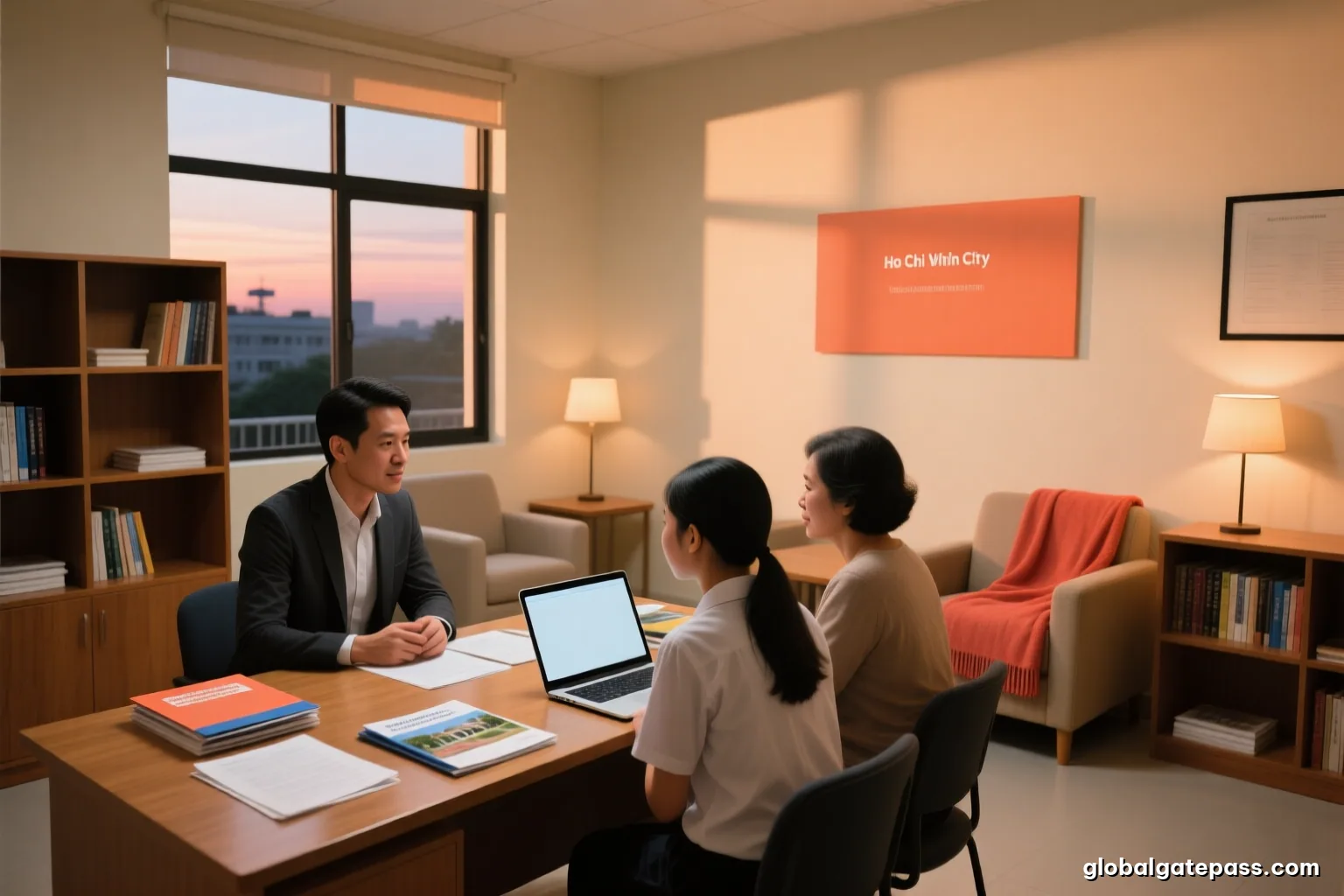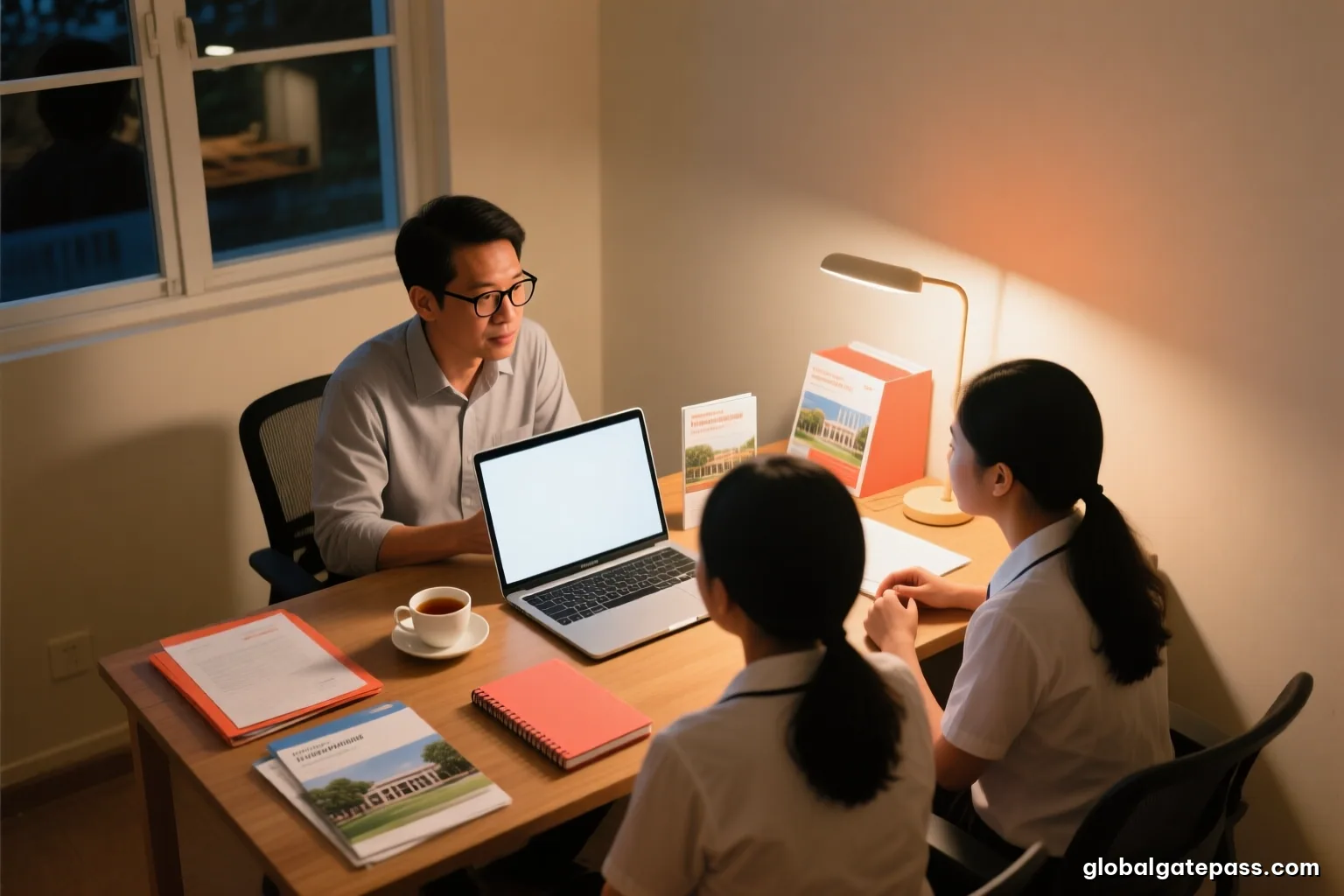
A boarding school admissions interview is a conversation that lets the school see who your child is without the paperwork in front of them: what they think about, what they care about, how they talk to a stranger and whether they genuinely want to study there. It is not a knowledge test. The best preparation is to help your child understand themselves and the school, then practise speaking naturally, without memorising model answers.
Many schools interview both the student and the parents; some interview on campus, some online, and some add an on-the-spot writing task or a conversation with a teacher. This article explains how Global Gate Pass mentors prepare students aged 13 to 16, the difficult questions, common mistakes and the parents' part in the interview.
What the school wants to see in the interview
The interviewer at a boarding school is usually an admissions officer, sometimes a teacher or the head of a boarding house. They are picturing your child at the dinner table, in a class of twelve, in the common room on a Saturday evening. Their questions revolve around three things: curiosity, how your child behaves with other people, and why they want to attend this school.
For international students, the interview is also where the school hears their real level of English. The school does not expect a 14-year-old to speak like a native speaker; it wants to see that your child understands the question, is willing to ask again when they do not, and can get their ideas across. A child who speaks slowly, sometimes searching for words, but answers honestly and with detail often leaves a better impression than one who fluently recites memorised lines.
Finally, the school watches whether this is your child's wish or only the parents'. The questions why do you want to board and why did you choose this school almost always come up. An answer with details specific to the school shows that your child has done their research.
Common question groups and how the mentor prepares
The mentor does not give the student a list of answers. The mentor gives a list of question groups, then works with your child to find real material for each group. The actual wording your child produces themselves in the practice sessions.
| Question group | Example question | What the school is looking for | How the mentor helps your child prepare |
|---|---|---|---|
| About yourself | Describe an ordinary day; how would your friends describe you | Whether your child knows themselves | Find two or three small stories with detail |
| About learning | Your favourite subject and why; a time you met a hard problem | Curiosity, how your child copes with difficulty | Choose a subject your child genuinely likes and one specific setback |
| About interests | What do you do in your free time; the last book you read | Whether your child has a life of their own beyond study | Talk about what your child actually does, even ordinary things |
| About boarding life | How do you feel about being away from home; what do you do when you feel down | Whether your child has thought about living away from home | Be honest about worries and how your child plans to deal with them |
| About the school | Why did you choose this school; what would you like to get involved in here | Whether your child has researched the school | Note three specific things your child likes about the school |
| Your child's questions | Do you have any questions for us | Whether your child is genuinely interested | Prepare two real questions your child wants answered |
The last group is often underestimated. A student with no questions for the school comes across as indifferent. A good question is one your child really wants to know the answer to and cannot find on the school's website.
Three typical practice sessions with the mentor
A typical practice schedule, which varies by student. At Global Gate Pass, the mentor responsible for the region leads the sessions and may bring in someone your child has not met so that the third session feels closer to a real interview.
- Session one, a conversation in Vietnamese: the mentor asks questions from each group and your child answers in Vietnamese to find ideas and stories. The goal is for your child to know what they want to say.
- Between sessions one and two: your child says the ideas again in English, records them on a phone, listens back and picks simpler words where they stumbled.
- Session two, practice in English: the mentor asks again in a different order and asks follow-up questions based on your child's answers so they get used to not knowing what comes next.
- Session three, a mock interview: an interviewer your child has not met, in the format the school will use, in person or online, at full length. No stopping midway for feedback.
- After session three: the mentor and your child review it together and pick only two or three points to adjust. Too much feedback at once makes a child lose their natural manner.
The number of sessions can be fewer or more depending on your child. Some only need one mock interview to calm their nerves; others need more time for spoken English. What the mentor avoids is so much practice that your child knows everything by heart and sounds as if they are reading.
Difficult questions and how to think about them
What is your weakness? There is no trap here. Your child names a real weakness, along with something specific they are doing to improve. Avoid fake answers such as I am too much of a perfectionist.
If you are not accepted here, what will you do? The school asks to see whether your child stays calm. Your child can simply answer honestly that they will carry on studying elsewhere and keep doing what they enjoy.
Tell us about a time you disagreed with a friend or an adult. The school wants to hear how your child handled it; it does not need a big story. An argument during a group project where your child listened and both sides chose a different approach is enough.
What if you do not understand the question? Asking again is completely normal. The mentor practises simple ways of asking again with your child, so they do not guess and answer off topic.
Questions about current affairs or a topic your child has not thought about. Your child does not need to know everything. Say what you know, say clearly where you are unsure and say how you would find out more. Honesty is valued more than a guessed answer.
The parents' part in the interview
Many schools have a separate conversation with the parents, before or after the student's part. The school wants to understand what the family expects, how they will support their child from a distance and whether they share honestly about their child. Parents should be ready to talk about their child as someone who knows them, including the things their child is still working on, and to ask real questions about the boarding house, the person who looks after international students and how the school keeps in touch with families.
During the child's part, parents usually do not sit in. If the interview is online at home, parents should leave the room. A student who glances at their parents before every answer gives the school the impression they are not ready to live independently. The mentor reminds the whole family of this in advance, because it is a very common mistake and a very easy one to avoid.
Parents should also avoid two things: answering for their child when the school asks the whole family a question, and overstating their child's achievements. The interviewer has already read the application; what they need from the parents is the view from home, a willingness to work together and realistic expectations. A parent who says clearly which subject their child is weak in and how the family has arranged support is usually trusted more than one who only lists strengths.
After the interview: write it down and use it next time
Straight after each interview, the mentor asks your child to note down the questions they were asked, which ones they felt they answered well and which ones caught them off guard. Writing this down takes ten minutes but is very useful when your child has several more school interviews in the same season. The question that surprised them at the first school often becomes one they answer well at the second.
These notes are also useful when choosing a school. Your child's impressions of the interviewer, of the atmosphere of the conversation and of the school's answers to their questions are real data, often more valuable than brochures. When results come in from several schools, the mentor goes back over these notes with the family before the final choice. A school that left your child feeling welcomed and listened to in the interview is usually also a school that looks after new students carefully.
Illustrative case: a shy student who speaks English slowly
An illustrative case, not a real one: a grade 8 student who writes English fairly well but speaks slowly and rarely starts a conversation. In the first practice session, they answer each question with one or two short sentences and stop.
The mentor does not push them to talk at length. Instead, the mentor helps them find the three stories they most like telling, then practise extending each answer with one detail: when, where, how it felt. Your child also practises an opening phrase to buy thinking time, a way of asking again when they do not understand, and two questions for the school. After the mock interview, they still speak slowly but answer fully and with detail, and they are more confident because they do not have to guess.
The school does not need a child who talks a lot; it needs a child who speaks honestly and can hold a conversation. The point of practice is to help your child be themselves for thirty minutes, not to turn them into someone else.
Getting ready for interview day
The logistics are simple but often overlooked, especially for online interviews across time zones.
- Check the interview time in the school's time zone and in Vietnam time, and write both down.
- For online interviews: test the device, connection and headphones the day before; choose a quiet room with a tidy background and enough light.
- Your child reviews the three things they like about the school and the two questions they plan to ask, not model answers.
- Eat lightly, sleep well, dress neatly as for school.
- After the interview, your child can send a short thank-you email written by themselves, if the school provides a contact address.
Book a free 60-minute first session, with no obligation, through the form on the Global Gate Pass Contact page, so the mentor can see where your child stands and how many practice sessions they need before interview season.
Frequently asked questions
How long does a boarding school interview last?
Usually from twenty minutes to an hour for the student's part, depending on the school; some schools add a conversation with the parents. Schools usually tell you the length and format in advance. The mentor practises at the actual length so your child gets used to the pace.
Is an online interview rated lower than an in-person one?
Many schools use online interviews as a normal format for international students. What matters is that your child comes across naturally and the equipment is well prepared. If you are able to visit, an in-person interview helps your child get a clearer feel for the school, but it is not required.
Should my child memorise model answers?
No. Interviewers spot memorised answers very quickly and usually ask follow-up questions to see what your child really thinks. Your child should prepare material, meaning stories and ideas, then practise speaking naturally in their own words.
Can my child be rejected because of weak spoken English in the interview?
Schools that recruit international students know your child is still learning English. They want to see that your child understands, can express ideas and is willing to ask again. If your child's level is still far from what is required, the school may suggest an English support programme or a lower grade; that is valuable information for the family to weigh up.
Can parents sit in while our child is interviewed?
Usually not during the child's part. Parents have their own part if the school arranges one. For an online interview at home, parents should step out so your child can answer independently and without distraction.
Should my child send a thank-you note after the interview?
It is not required, but a short thank-you written by your child is a polite gesture. It should be short and mention one thing your child remembers from the conversation. Parents should not write it for them.