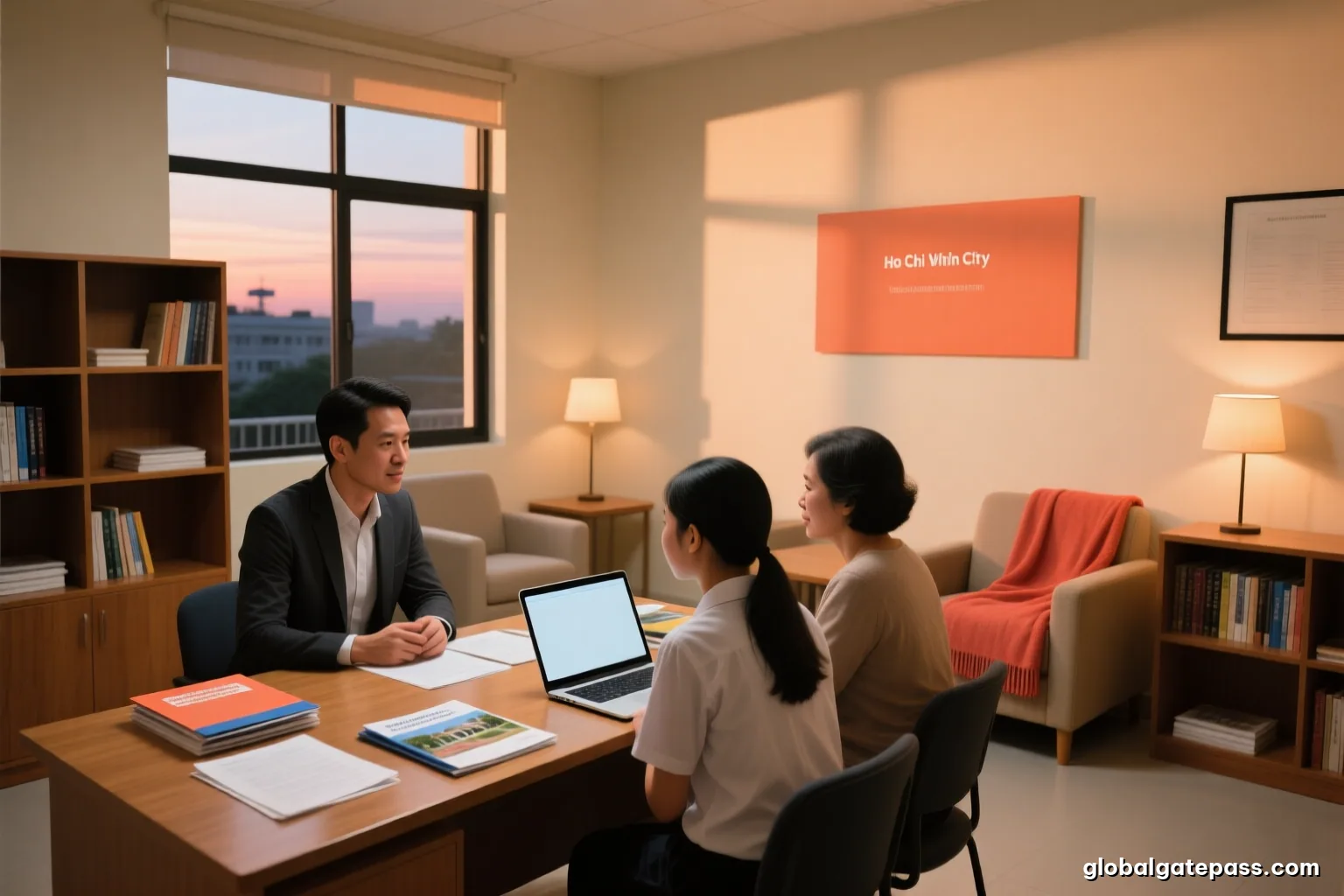
The boarding school that suits your child is not the most famous name on the list the family receives, but the place where your child can live every day: sleep there, eat there, study there and stay through the weekend. Global Gate Pass mentors choose boarding schools along five axes: the size of the school, the share of students who actually board, the rhythm of daily life, how structured the rules are, and how the school looks after international students. Academic standing and results are considered, but after these five axes.
The reason is very practical: for a university student, the institution is a place to study; for a 14- or 15-year-old boarder, the school is home. An excellent school whose rhythm is wrong for your child can make them withdraw for the whole first year. This article goes through each axis, how the mentor talks with your child to find out which kind of school suits them, and the signals to read when visiting a school or joining an online information session.
Why personality matters more at this stage
At boarding school, everything happens on one campus: lessons, evening prep, shared meals, compulsory sport at many schools, lights out. Students have no private space outside school the way university students do. An introverted child who needs time alone to recharge will find a single room and a four-person room worlds apart, and the same goes for a school with quiet corners compared with one where every space is crowded.
Personality does not decide whether your child does well academically, but it does decide whether they have the energy to study at all. Mentors have seen many cases of students with strong grades who chose a good school but did not fit its daily rhythm, and whose marks dropped in the very first term. Conversely, some students with average grades who chose the right environment took off very quickly. That is why the academic axis comes after, not out.
Personality between 13 and 16 is also still changing. The mentor does not box your child into one type, but looks for an environment broad enough for them to grow into: a quiet child today may be leading a club two years later, if in the first year they are in a place where they feel safe. Choosing a school by personality is therefore choosing a comfortable starting point, not a fixed mould for all four years.
Five axes mentors use to set schools beside personality
The table below does not score any school. It only shows which way each axis should lean for each kind of student, so the family can read school information with different eyes.
| Axis | Question to ask the school | Suits students who | Points to weigh |
|---|---|---|---|
| School size | How many students per year group, how big is an average class | A small school suits a child who needs adults keeping a close eye; a large school suits a child who likes choosing from many subjects and clubs | Small schools offer fewer advanced subjects; in large schools a quiet child can slip out of sight |
| Share of boarders | What percentage stay on campus over the weekend | A child far from home needs a community that stays with them | A school with many day students has an empty boarding house at weekends |
| Daily rhythm | The daily timetable, whether there are Saturday lessons, whether afternoon activities are compulsory | A child who needs a clear schedule; a child who loves sport and being active | A child who needs free time may feel suffocated by a packed timetable |
| Level of structure | Rules on phones, prep time, going out, how breaches are handled | A child who needs boundaries to manage themselves; families who want clear structure in the first year | Structure that is too loose for a child not yet self-managing; too tight for one already used to independence |
| Care for international students | Is there English support, who is responsible for international students, what share are Vietnamese | A child who needs language support in the first year | Too many students of the same nationality easily form a closed group; too few can mean loneliness |
The question about how many stay at weekends is often skipped, yet mentors give it a lot of weight. A school called a boarding school where most students go home every weekend is very different from one where almost everyone stays.
The personality session the mentor runs with your child
Before building a list of schools, the mentor spends a separate session with the student. It is not a quiz and there is no score; the aim is for your child to describe in their own words how they live and study.
- Your child describes an ordinary day from waking up to going to bed, and the mentor notes the stretches when they need to be alone and the stretches when they like being with others.
- Your child talks about a recent time they felt tired or stressed, and what they did to recover. The answer shows how they recharge.
- Your child chooses between pairs: studying in their own room or in a busy library; a team sport or an individual activity; a timetable set for them or one they plan themselves.
- Your child says what worries them most about living away from home. This question often opens up something more important than any academic question.
- The mentor reads the notes back and asks whether they are right; your child corrects anything that is not.
Only after this session does the mentor meet the whole family again to set those notes beside the five axes above. Parents are often surprised that their child says something different from what they expected, and that is why the session has to be held separately.
Reading the signals on a school visit or at an information session
Look at the boarding house, not just the teaching buildings. Classrooms, labs and sports halls tend to look good at every school. The boarding house, common rooms and dining hall are where your child will actually live. Ask to see a real room, not a show room.
Talk to the head of the boarding house, not just the admissions office. The houseparent knows exactly what a Saturday evening at school looks like, who sits with a new student crying from homesickness, and when phones are collected.
Listen to current students. If the school arranges a meeting with a student, ask what they like most and what they would like to change about the school. The second answer is worth more.
Notice how the school talks about international students. A school with a specific plan for the first week, a dedicated person in charge and subject-based English support is usually used to looking after students from far away. A school that only says in general terms that international students integrate very well needs further questions.
Write down your child's impressions straight after the visit. A student's first impression is often more accurate than any comparison table. The mentor asks your child to note three things they liked and three things that worried them on the same day.
Illustrative case: two schools offer a place, your child prefers the smaller one
An illustrative case, not a real one: a quiet student who loves drawing and reading is accepted by two boarding schools. The first is large, well known and offers many advanced classes. The second is small, in the countryside, with small classes, and almost every student stays at weekends.
The parents lean towards the first because they think their child needs a challenge. The child leans towards the second because, after the online visit, they noticed that the houseparent knew every student by name. The mentor puts both schools on the five axes and shows that the second school is stronger on four out of five for this particular child's personality, while the first is stronger only on the number of advanced subjects. The mentor also checks whether the small school offers the subjects your child needs for the degree they plan to study later.
In situations like this, mentors usually advise the family to listen to the child a little more, provided the school the child prefers lacks nothing essential for their future studies. A student living somewhere they feel safe finds it easier to stretch themselves than one who has to brace themselves every day.
Common mistakes when choosing a boarding school
The mistakes below almost always come from using university selection criteria to choose a boarding school.
- Choosing by exam league tables without looking at what an ordinary day at the school is like.
- Choosing a school with many Vietnamese students for peace of mind, and then your child speaks only Vietnamese all year and their English does not improve.
- Choosing a school with few Vietnamese students to force your child to integrate, when your child really needs someone who speaks the same language for the first few months.
- Not asking about weekends and holidays, and only later finding out that the boarding house closes at certain times and your child has to go somewhere else.
- Ignoring your child's view because they are thought to be too young to choose.
There is no formula that is right for every family. The mentor helps the family see all the axes so that the decision has a basis, and then respects that decision.
Building the school list with a mentor
The academic axis comes after the five living axes, but it is not dropped. After filtering by personality, the mentor checks each remaining school on three points: does it offer the subjects your child needs for their intended university direction; does it give subject-based English support to first-year students; and how does it prepare students for university applications in the final year. However well a school fits personality-wise, if it lacks the subjects your child needs, it still has to go.
A good boarding school list is usually shorter than a university list, because each school needs time to research properly and many hold their own interviews. The mentor builds the list after the personality session, then researches each school in depth with the family before deciding where to apply. Each school on the list has its own notes page: where it fits your child, what still needs asking, and who at the school answered those questions. This notes page stays with the application all the way to the final choice of school.
Families can start with a free 60-minute first session, with no obligation. It is best for your child to attend and do much of the talking. Book through the form on the Global Gate Pass Contact page; the mentor responsible for the region you are interested in will take the session personally.
Frequently asked questions
Is a co-educational or a single-sex boarding school a better fit?
There is no general answer. Some students focus better at a single-sex school, others find it unnatural. The mentor looks at how your child interacts at their current school and asks which setting they feel comfortable in, then places this axis alongside the others rather than deciding on it alone.
How do full boarding and weekly boarding differ for international students?
International students usually have no home to go to every weekend, so at a school where most students go home, your child will be left in an empty boarding house. For Vietnamese students, mentors usually favour schools where a high share stay and where weekend activities are organised.
Should an introverted child go to boarding school?
They can, if the school is the right one. An introverted student needs quiet space and adults who keep an eye out without pushing them to take part all the time. A small school with rooms shared by few students and quiet study areas usually suits them better. The mentor asks the school specifically about room arrangements for the first year.
Should we choose a school with many Vietnamese students?
A few classmates who share the language help your child through the first month. Too many students of the same nationality easily become a closed group, and English improves slowly. The mentor asks the school for the actual proportion and how it allocates rooms so that students of the same nationality do not share one.
If we cannot visit in person, how can we find out about a school?
Join an online information session, ask for a separate call with the head of the boarding house and the person in charge of international students, and ask the school to connect you with a current parent or student. The mentor prepares a list of questions for each session so the family does not miss the boarding side.
What if our child wants a different school from the one the parents prefer?
The mentor puts both schools in the same comparison frame and shows the family where each one is stronger. Disagreements usually shrink once everyone is looking at the same table. If they still differ, the mentor advises taking the child's view seriously, because the person living at the school every day is the child.