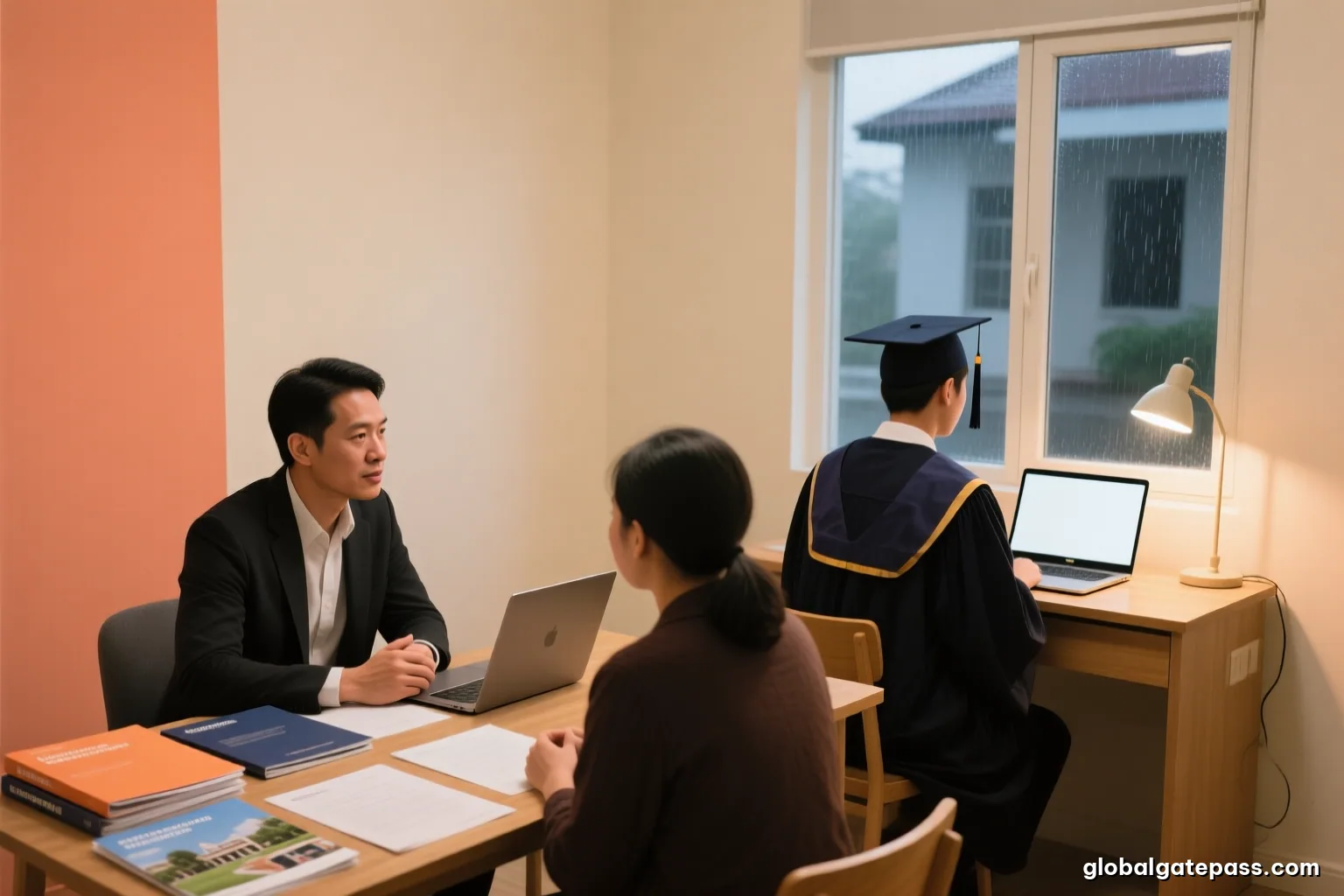
The private session for parents is a Global Gate Pass working session for mothers and fathers, held separately from the mentor's sessions with the student, to discuss the matters that are the family's responsibility: the real cost of the whole course, legal and financial risks, managing money while the child is abroad, how to stay in touch, and a contingency plan if things do not go as expected.
Studying abroad is a decision for the whole family, but in many consultations the time goes on schools, majors and the child's scores, while the questions parents really worry about are left to the end of the session or never asked. The private session exists to give those questions their place back, without hurry and without interruption. This article describes what the session covers, what parents should bring, and what the session does not do.
Why parents need a session of their own
When the student and the parents sit at the same table, some things are hard to say plainly. The student is reluctant to say they are not sure they want to go; the parents are reluctant to say in front of their child that the budget is limited; both are reluctant to discuss "what if our child can't keep up?". As a result, the plan is built on assumptions nobody has checked. A private session lets parents ask every question, including the hard ones, without worrying about how it will affect their child's morale.
The second reason is the division of responsibility. The student is responsible for studying, writing essays and attending interviews. The parents are responsible for the finances, the family's documents, the decision to sign the contract and what to do if something goes wrong. These are two different sets of tasks that need two different conversations. The parents' work is what only parents can do: family documents, sources of funds, signatures and the final decision. Essays, correspondence with schools and interview preparation are best left to the child, because they are also part of the application that is assessing the child. The private session applies that division to each family's particular circumstances.
The private session does not replace the family talking among themselves. Mentors usually end the session with a few questions for the parents to take home and discuss with their child, and then everyone returns to the joint session with a clearer picture. For many families, the joint session that follows is shorter and goes straight to the point, because what needed agreeing has already been said at home rather than held back out of reluctance.
The five main topics of the session
The real cost of the whole course. Not just the first year's tuition but the total cost from preparing the application to graduation: test fees, application fees, visa fees, insurance, flights, accommodation deposits, living costs for the city and a contingency. The mentor provides a frame for the family to fill in the figures for the options it is considering.
Legal and administrative risks. The things that can derail the plan: family documents that do not match each other, financial information that is hard to explain, changes in the destination country's rules partway through, and the conditions for keeping the visa while studying. The mentor makes clear which risks can be controlled and which the family can only prepare for mentally.
Managing money while your child is far away. How often to send money, through which channel, whose name the account is in, how much the child can decide on their own, and how the child can learn to manage spending while the parents still know what is going on.
How to stay in touch. Agreeing in advance on how often to call, who the emergency contact is in the destination country, what support channels the school has for international students, and where the mentor fits in that chain of contacts.
A contingency plan. If your child does not reach the test score, if the visa is refused, if the first year proves too hard, if the family has a financial setback: what options exist for each situation, when the decision will be made, and who in the family will make it.
Real costs: a frame the family takes home to fill in
The mentor does not give a cost figure that applies to every family, because costs depend on the country, the city, the school, the accommodation and the student's lifestyle. Instead, the session builds a frame with the family based on groups of costs like those below:
| Cost group | When it is paid | Notes for filling in |
|---|---|---|
| Preparing the application | Before applying | Test fees, application fees, translation, notarisation |
| Visa and travel | After the offer arrives | Visa fee, medical check if required, flights |
| Tuition | Per term or per year | Read the school's fee schedule, deduct any scholarship |
| Accommodation and living costs | Monthly | By city and type of accommodation |
| Health insurance | According to the destination's rules | Some countries require it to be bought before the visa application |
| Contingency | Kept in reserve | For exchange rates, illness, a change of accommodation |
The first-year budget should be drawn up as a month-by-month cash flow, not just one figure for the year, because the large items are concentrated in the first few months: the first term's tuition, the accommodation deposit, flights, insurance and initial supplies. In the private session, the mentor uses that frame to go through each option the family is considering, pointing out costs that are often forgotten and costs that can be reduced without affecting the studies.
What parents should bring
The private session works best when parents have thought about a few things beforehand. No complicated documents are needed, but it helps to have:
- The budget the family can set aside for the whole course, including the maximum that cannot be exceeded.
- The expected sources of money for the studies: savings, monthly income, a business, assets, support from relatives.
- The parents' biggest worries, written down in advance so they are not forgotten during the meeting.
- The family's expectations after graduation: returning to Vietnam to work, staying abroad for a while, or no direction yet.
- Details of any relatives living abroad, because this affects accommodation, guardianship and the visa application too.
- Questions about the service contract if the family is considering signing.
Financial information parents share in the session is used only to advise on the family's application. Parents are not required to give exact figures; an estimated range is enough for the mentor to speak honestly about the feasible options.
When parents and child do not yet agree
Parents wanting their child to go to one country while the child wants another, or parents wanting a stable major while the child wants the one they love, happens far more often than many families think. Sometimes the child does not really want to go but has not dared to say so. The private session is when the mentor helps parents look at those signals calmly: does the child research schools and majors on their own initiative or only follow the timetable the parents set; how far does the child manage daily life on their own; how do they react when facing something difficult without family nearby?
The mentor takes no side. The mentor's job is to provide facts: what career paths the major the child wants leads to, whether the country the parents want suits the profile and the budget, and what the trade-offs are if each side's option is chosen. Once the facts are clear, the family conversation is usually much less tense than when each person has only their own feelings to go on.
In some cases the mentor will advise the family to defer by one intake or choose a stepping stone, such as a foundation programme, a short-term programme or a year of work, to give the child more time to decide. That is not easy advice to hear, but it is the right advice for the way Global Gate Pass works. Deferring an intake by a few months costs far less than an unfinished academic year because the child was not ready, both financially and for the morale of the whole family.
A contingency plan: discuss it while everything is still normal
The part most families skip is the plan for when something goes wrong. When everything is going smoothly, talking about your child falling seriously ill abroad or losing their passport feels like bad luck. But when it happens, the family has to decide quickly while worried, and what has been discussed in advance helps a great deal: who the contact person is in the destination country, where the copies of documents are kept, what the insurance covers, and whom to call first.
The mentor goes through the common situations with the parents and each side's part in them: the child falling ill or being hospitalised, losing a passport or documents, losing money or being scammed, problems with accommodation. The private session helps the family turn those situations into its own concrete list, with names, contact channels and where documents are kept.
The contingency plan also covers studies: if the child fails a course, receives an academic warning or wants to change major. For students on the full-journey package, the mentor remains a point of contact in the first year. Even so, the private session always reminds parents that the school is the body with authority and the official sources of support, and the child needs to know how to reach the school's student support services.
What the private session does not do
It does not push you to sign a contract. The private session falls under our commitment to a free, no-obligation first session. Parents can listen, go home to think, and decide not to use the service.
It does not decide for the family. The mentor provides facts and assessments and says clearly when an option looks too risky, but the decision on country, school and timing belongs to the family.
It does not give advice on investments, loans or buying and selling assets. If the family is considering borrowing or selling assets to pay for the studies, the mentor only helps look at the effect on the application and the budget; the financial decision itself should be discussed with a bank or a financial professional.
It does not build documents or "dress up" finances. Every option discussed is based on the family's real money and real documents. When the real budget is not enough for the option the family hopes for, the mentor will say so plainly and look for a more affordable option together, such as a country with lower costs, a programme with automatic scholarships, or a two-stage transfer route.
Frequently asked questions
Is there a fee for the private session for parents?
The private session falls under Global Gate Pass's commitment to a free, no-obligation first session. For families already using the service, further sessions with parents are covered by the scope of the package they signed, at no extra charge.
If only one parent can attend, should we still book?
Yes. The mentor will send a summary of the main points after the session so the absent parent is informed. Even so, for major decisions about finances and the contingency plan, both parents should ideally attend a session together before signing a contract.
Can parents in other provinces or living abroad take part online?
Yes. The private session can be held by video. Parents should choose a quiet place and send their main questions in advance so the mentor can prepare, because online sessions usually need to get to the point more quickly.
If our child doesn't yet know which country to go to, is the private session useful?
Very useful, because this is when the family's budget and expectations help narrow down the choices. Knowing the maximum spend and the plan after graduation in advance rules out many unsuitable options before the child puts effort into preparing.
Can we book a private session for parents once our child already has an offer?
Yes. At that point the session usually focuses on the finances for the visa application, managing money in the first year, accommodation and the emergency plan. The mentor will read the offer in advance so the session can go straight to the remaining tasks.
Will what parents say in the private session be passed on to the child?
The mentor respects what parents want to keep private, such as the maximum budget or financial worries. For information the child's application needs, the mentor will discuss with the parents how and when to share it with the child.