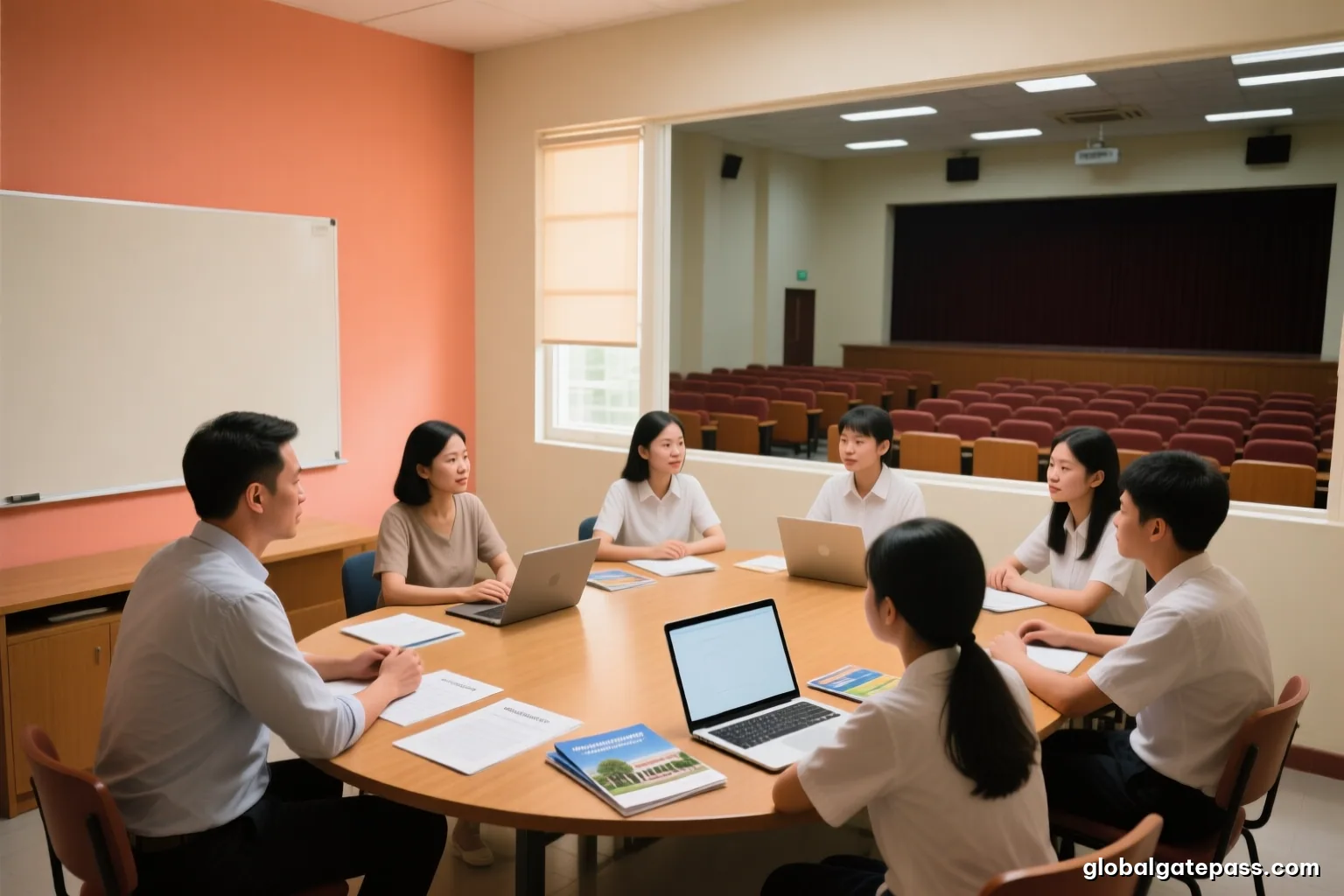
Small teaching-focused colleges, such as liberal arts colleges in the US or small-scale universities in other countries, suit students who learn well through small classes, discussion and close relationships with lecturers, especially students not yet sure of their major. Large research universities suit students who are independent, already clear about their direction, and need a wide choice of modules, laboratories and a broad environment. A Global Gate Pass mentor looks at how the student learns first, and only then discusses the type of school.
This is one of the decisions Vietnamese families consider least, because few people in Vietnam know about the small teaching-focused model. Many families only search among large universities that appear in rankings. This article sets out where the two models differ, how to tell which one suits a student, common misconceptions, and how to include both in one list.
Where the two models differ
The table below compares the two models on the points that most affect the learning experience. These are general characteristics; individual schools can differ, so always check on the school's website.
| Point of comparison | Small teaching-focused college | Large research university |
|---|---|---|
| Size | A few thousand students, mostly undergraduates | Tens of thousands of students, many of them postgraduates |
| First-year classes | Small classes, lots of discussion, taught directly by lecturers | Large lecture halls, with discussion groups often led by teaching assistants |
| Curriculum | Broad, liberal, major chosen late | Many specialised majors, some with direct entry |
| Research | Undergraduates can work with lecturers because there are few postgraduates | Large research facilities, but undergraduates must actively seek opportunities |
| Campus life | A close-knit community, often in a small town | Diverse, often in a city or on a large campus |
| Engineering | Few colleges offer it; some have joint programmes with engineering schools | Usually offered in full |
Neither model is better than the other. Each suits a type of student, and many students can do well in both. The question is where the student will develop best.
Read how your child learns before reading the type of school
Do you learn better by being asked questions and discussing, or by reading and working on your own? Students who ask a lot of questions, enjoy debate and need frequent feedback usually develop well in small classes. Students who study well on their own, like finding material themselves and do not mind large lecture halls can adapt well to a large university.
Are you sure of your major? Students not yet sure benefit from the broad curriculum of a small college, where first year covers many fields. Students with a clear direction, especially in engineering, may need a large university with specialised programmes.
Do you go looking for opportunities? At a large university there are many opportunities, but you have to find them yourself: knock on lecturers' doors, sign up for societies, find internships. At a small college there are fewer opportunities, but they usually come closer to you.
Do you suit a small community or a diverse environment? Some students feel secure in a small community where everyone knows each other. Others find it stifling and need a large, diverse environment.
Is your English good enough to take an active part in class? Small classes require students to speak a lot and join discussion constantly. This is a chance to develop quickly, but also a big challenge for students who are not yet confident speaking.
Misconceptions about small colleges
Many families drop small colleges from their list because of the following misconceptions. Mentors meet them often and explain:
- "A small college is a weak college." Many small teaching-focused colleges are highly selective and teach very well. Small size says nothing about quality.
- "Nobody in Vietnam knows the name." This is partly true, and worth weighing if the student plans to return to Vietnam to work in a field where the school's name matters. But for postgraduate study, international employers, or working in the host country, a small college's name is usually known within its circles.
- "There are no research opportunities." On the contrary, because there are few postgraduates, undergraduates at small colleges often get to do research with lecturers earlier.
- "Fewer job opportunities." It depends on the school and field. Some small colleges have very loyal alumni networks, and careers offices that work closely with each student.
None of this means small colleges suit every student. It only means small colleges should not be ruled out because of misconceptions.
Misconceptions about large universities
Conversely, there are also misconceptions about large research universities that make families worry unnecessarily, or expect the wrong things:
- "Students get left behind at a large university." Many large universities have honours programmes, small first-year seminars and dedicated academic advisers. Proactive students still have a close-knit experience.
- "Famous professors will teach you." In first year, many large courses are lectured by faculty while discussion groups are led by teaching assistants. Getting to know a famous professor usually takes initiative.
- "A large university definitely has more opportunities." There are more opportunities in number, but also more students competing for them. International students need to know how to find and win opportunities.
- "Studying at a large university means better outcomes." Outcomes depend on the specific programme and on the student. Each field's outcomes report says more than the size of the school.
The mentor does not advise avoiding large universities, but helps students understand what that environment will ask of them, so they can prepare their mindset in advance.
Outside the US: the same choice in a different form
The liberal arts college model is characteristic of the US, but the choice between a small teaching-focused environment and a large research-focused one exists everywhere. In Canada and Australia, there are smaller universities focused on undergraduate study, with smaller classes than the large research universities in the cities. In Germany and the Netherlands, there is a system of universities of applied sciences, focused on practice and linked to industry, alongside research universities.
In the UK, besides the size of the school, the organisation also differs: some universities have a college system with small-group teaching, while others have a personal tutor system. This is information to read carefully on each university's website.
For students applying to several countries, the mentor asks the same question for every country: how many people will be in your classes, who will teach you, and will you have direct contact with lecturers? The answers help compare schools in different countries on the same footing.
An illustrative scenario: two students, two choices
Hypothetical scenario one: a student who does well in social science subjects, asks lots of questions, enjoys debate, and is undecided between economics, public policy and psychology. She likes reading but not memorising. The mentor suggests she look closely at a few small teaching-focused colleges, where she could try all three directions in first year, discuss in small classes and do research with lecturers early.
Hypothetical scenario two: a student who is very strong at maths and programming, studies well on his own, has done several personal projects, and is certain he wants to study software engineering. He likes a large environment, lots of tech societies and being close to companies. The mentor suggests a list made up mainly of research universities with strong engineering, plus one small college with a joint engineering programme for comparison.
Both lists include both models. The difference is the proportion, and that proportion comes from how each student learns, not from reputation.
Try before deciding: ways for students to get a feel for it
Reading descriptions of the two models is no substitute for experience. The mentor encourages students to get a feel for both before settling the proportions in their list, in ways that do not cost much.
The first way is to attend online sample classes or watch open lectures from both types of school, noticing whether you feel comfortable with one-way lectures or with constant questions and answers. The second is to talk to students at both types of school about an ordinary week of study. The third, if the family has the means and time, is an academic summer course at a university, where the student lives and studies for a few weeks in a real environment.
Even in Vietnam, students can observe themselves: do you learn better in a small tutoring class or a large one, do you ask teachers a lot or find material yourself, are you comfortable doing group projects? These observations, when shared with the mentor, often give a clearer answer than any comparison table.
Questions to check on the school's website
To know which model a school really belongs to and whether it suits the student, the mentor guides the student to find the following on the school's website, in the common data set for US schools, or by asking directly:
- The student-to-faculty ratio and the average size of first-year classes.
- Who teaches first-year courses: lecturers or teaching assistants.
- Whether undergraduates can do research, from which year, and what percentage take part.
- How academic advisers are assigned, and how many students each adviser looks after.
- Whether the programme requires broad study in first year, and when a major must be chosen.
Global Gate Pass's US and Canada mentor, Lâm Hà Phương, usually includes both models in the initial list for North American applications, then lets the student get a feel for them through online information sessions and conversations with students. If you want to know which model suits your child, you can book a free 60-minute first consultation through the form on the Contact page.
Frequently asked questions
Do liberal arts colleges teach business or computer science?
Many have computer science and economics, and some have business. These fields are usually placed within a broader education. Students who want specialised engineering should check carefully, because not many small colleges offer a full engineering programme.
Are scholarships at small colleges different from those at large universities?
Some small colleges have substantial financial aid budgets for international students because they want to increase diversity. Policies vary a great deal between schools, so read each school's specific policy.
Should introverted students choose a small college?
Not necessarily. Introverted students may find small classes stressful because they have to speak a lot, but they may also find them more comfortable because the groups are small and familiar. The mentor asks carefully how the student learns rather than guessing from personality.
Can a student go from a small college to a master's at a large university?
Yes, and many small-college students follow this path. Postgraduate applications look at academic results, research experience and recommendations; small colleges often help students get in-depth recommendations from lecturers who know them well.
Should a student apply to only one model?
A student who is very sure about how they learn and what they want to study can focus on one model. For most students, the mentor suggests having both on the list, so there are choices when results come in.