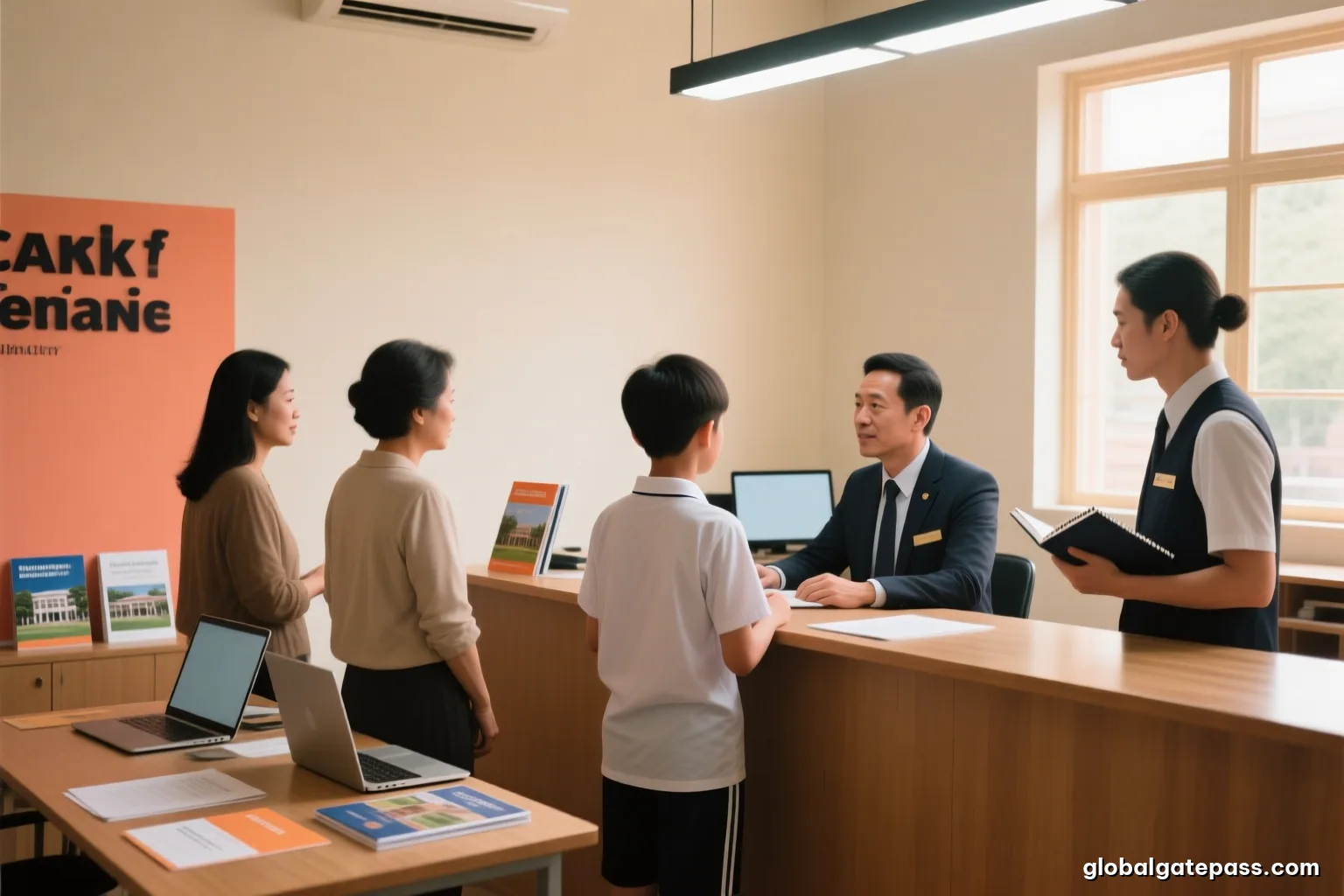
Having relatives living in the country you plan to study in does not lead to automatic refusal, and in many cases it is even a plus for housing and early support. But for student visas that require applicants to show a temporary study purpose, relatives in the destination make the officer ask one more question: do you plan to stay? The principle the mentor sets: declare every relative the form asks about, fully and accurately, then build the rest of the file so that question has a clear answer.
This article covers how Global Gate Pass handles the situation: why relatives must not be hidden, which relationships officers pay attention to, how to build ties to Vietnam, points to note when a relative is the financial sponsor or provides housing, preparing interview answers, an illustrative scenario and common mistakes.
Why relatives must not be hidden
Many visa application forms ask about relatives in the destination country, some in great detail: name, relationship, residence status. Families sometimes think leaving them out makes the file "cleaner". This is a dangerous idea. Information about relatives may already be in those relatives' own files, in the family's previous visa applications, or may come out in what you yourself say at the interview.
When an officer discovers a relative who was not declared, the issue is no longer that relative but the honesty of the whole file. An application with relatives in the destination can still be approved; an application recorded as containing a false declaration is much harder, and that record can follow you into later applications.
So at the very first visa session, the Global Gate Pass visa specialist draws up a list of relatives in the destination country with the family: who they are, how they are related, what status they hold, and how they connect to your study plans. This list helps you complete the form correctly and prepare for questions in advance.
The degree of relationship and the degree of attention
Not every relative is read the same way. The mentor uses the framework below to know where preparation should be heaviest.
| Relative in the destination | What the officer usually looks at | Part of the file that needs strengthening |
|---|---|---|
| Distant relatives, little contact | Little, mainly whether you declared fully | Declaring correctly on the form is enough |
| Aunts or uncles who have settled | May ask whether you will live with them and who pays the costs | A clear study plan and post-study plan |
| Siblings studying or working there | Whether the family is gradually moving over | Your parents' and your own ties in Vietnam |
| A parent living there | Whether the real purpose is reunion or study | The reasons for choosing the school and programme; an explanation of the family situation |
| A relative who is the financial sponsor | The source of funds, obligations, intent to stay | Financial documents, the commitment letter, the plan to return |
Each country assesses this in its own way, and some visa types do not require proof of intent to return in the same way. The mentor reads the destination country's current guidance before deciding how much to prepare.
Building ties to Vietnam: not a single piece of paper
Ties are a whole picture. No single document proves "I will come back". The officer looks at the overall picture: where your family is, where the assets are, where unfinished work or study is, and where your career plan is anchored.
The post-study plan must be specific. For a student with relatives in the destination, "I will return to Vietnam after studying" is not enough. You need to be able to say what you will do, in what kind of environment, and why the knowledge from this programme is valuable in Vietnam.
The family is still anchored in Vietnam. Parents, siblings, and the family's jobs or business in Vietnam are the easy-to-see part of your ties. If most of the family is already in the destination country, the ties have to rest more on your personal plans.
The programme must make sense. A programme suited to your level, a field that connects to your past, a school chosen for academic reasons and not because it is near your relatives. A well-reasoned programme choice is an important indirect tie.
When a relative provides housing or is the sponsor
Many families choose a country where they have relatives because housing is convenient. That is perfectly reasonable, but it needs presenting clearly. If you will live with a relative, the file needs a letter confirming accommodation and the address, and more importantly, the chosen school must have its own academic reason, not just being near the relative's home. The officer will see the difference between "I chose the school and it happens to be convenient to stay with my aunt" and "I chose my aunt's house and then found a school nearby".
When a relative is the named financial sponsor, preparation is heavier. Besides the financial documents required by the rules, the officer may ask why the relative is supporting you and about your intent to stay. Some countries have specific rules on sponsors who reside there. The mentor reads the current guidance carefully and weighs with the family: should the relative sponsor, or should the parents in Vietnam be named with the relative only providing housing? Which option tells the clearer story?
There is no option that is right for every family. The decision rests on where the money really is and who is really paying. Global Gate Pass does not advise moving money around just to make the file look "nicer".
Preparing interview answers
Questions about relatives usually come up naturally in the interview. You need to answer calmly, truthfully and briefly. Practice usually covers the following questions:
- "Do you have relatives here?" Answer exactly as you declared, nothing added or left out.
- "What do they do, and what is their status?" You need to know the basics, but there is no need to describe their lives in detail.
- "Will you live with them?" Answer according to your plan, with a reason for choosing the school that does not depend on housing.
- "After your studies, will you stay with them?" This is the key question. Answer with a concrete plan in Vietnam, not a general promise.
- "Why did you choose this country?" Academic reasons come first; relatives are only a matter of convenience.
The visa specialist practises these questions phrased in many different ways, so you are not caught off guard when a question comes from an unexpected angle. The aim is answers consistent with the form and the study plan, said in your own words rather than recited.
An illustrative scenario: an aunt who has settled, and a foundation programme near her home
This is an illustrative scenario, not a real file. A grade 12 student has a maternal aunt who has been settled for many years in the country the student plans to go to. The family wants the student to take a foundation programme at a school near the aunt's home so she can look after him, then move on to university. The parents are in Vietnam, salaried employees, with a house and a younger child in lower secondary school.
At the visa session, the visa specialist turned the question around: without the aunt, would you choose this school? The initial answer was "not sure". So the regional mentor reviewed the school list against the student's academic profile and found two more suitable programmes, one of them still in the same city as the aunt. The reason for choosing the school now stood on its own: the programme had a pathway into exactly the field the student wanted.
The file declared full information about the aunt, stated clearly that the student would live with her in the first year, and had the parents in Vietnam as the named financial sponsors. Interview practice focused on the post-study plan and the reason for choosing the programme. The relative was still part of the story, but no longer the main reason for the whole application.
Common mistakes with files that involve relatives in the destination
The mistakes below turn an ordinary situation into a weakness:
- Not declaring relatives for fear of being judged, and then being found out.
- Choosing a school only because it is near relatives, with no academic reason.
- A vague post-study plan, or letting slip a wish to stay and work long term when the visa type requires temporary intent.
- A relative sponsoring financially without the documents that country's rules require.
- Knowing nothing about the relative you declared, so your answers are hesitant and look suspicious.
At Global Gate Pass, cases with relatives in the destination are handled jointly by the regional mentor and the visa specialist, from school selection to the visa file. Families with relatives in the intended study country can book a free sixty-minute first session through the form on the contact page to review their situation in advance.
Countries and visa types read this situation differently
Not every student visa weighs intent to return in the same way. Some countries require applicants to show a temporary study purpose and very clear ties to home; some assess mainly whether the applicant is a genuine student, has enough funds and meets the programme requirements; some even have a legal pathway from study to post-graduation work. So with the same situation of having relatives in the destination, the level of preparation differs from country to country.
The mentor does not use one script for every country. Before preparing the explanation, the visa specialist reads the current guidance for the exact visa type you will apply for, identifies which criteria are being assessed, and only then decides which parts of the file need building up. For families torn between two or three countries, how each country reads the relatives situation is also one of the factors in the comparison table when the Roadmap is drawn up, alongside academics, finances and scholarships.
What does not change between countries is the principle of declaring fully and telling the truth. The only difference is which part of the file needs more careful preparation.
Frequently asked questions
Does having a sibling studying in the same country affect the visa?
It is usually not a negative, especially when the sibling is studying within the rules. The officer may ask about both of your plans, so you need to state your own plan clearly. If the sibling has ever breached visa conditions, discuss it carefully with the visa specialist before applying.
Should relatives abroad write an invitation letter?
An invitation letter or accommodation confirmation is only needed when you will actually live with them or when the rules require it. The letter should be short, stating the relationship, address and length of stay. It should not be used to "guarantee" that you will return home, because relatives cannot guarantee that on your behalf.
Do distant relatives I rarely contact need to be declared?
Read the question on the destination country's form carefully. If the form asks about close relatives, declare close relatives; if it asks broadly, declare within exactly that scope. If unsure, declare, because declaring fully is safer than leaving someone out.
Can I get a student visa if one of my parents lives in that country?
It depends on each country's rules and the specific circumstances. This situation is more complicated because the officer needs to distinguish the purpose of study from the purpose of family reunion. The file needs a very clear academic reason, and sometimes a more suitable visa category should be considered. Individual advice is recommended.
Can I say I would like to work there for a few years after studying?
Some countries have legal post-study work programmes, and mentioning them is not wrong. But for a visa type that requires temporary intent, you need to show a long-term plan anchored in Vietnam. Your answer should be honest and balanced, without promising anything you do not intend to do.
How does Global Gate Pass help when there are relatives in the destination?
The regional mentor rechecks the reason for choosing the school so it stands independently of the relatives, the visa specialist guides you in completing the form correctly and preparing housing or sponsorship documents if needed, and practises the questions about your intentions after study with you.