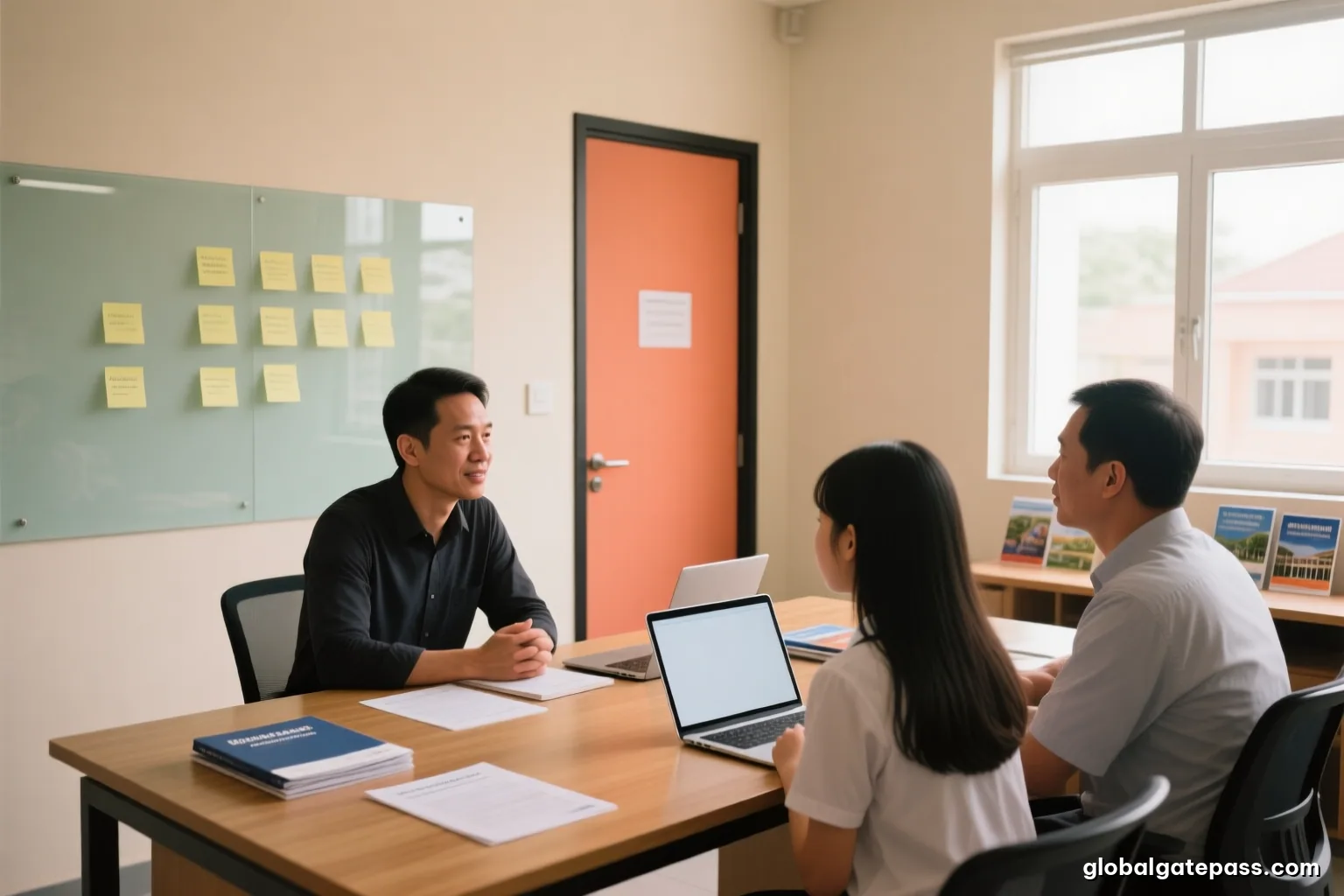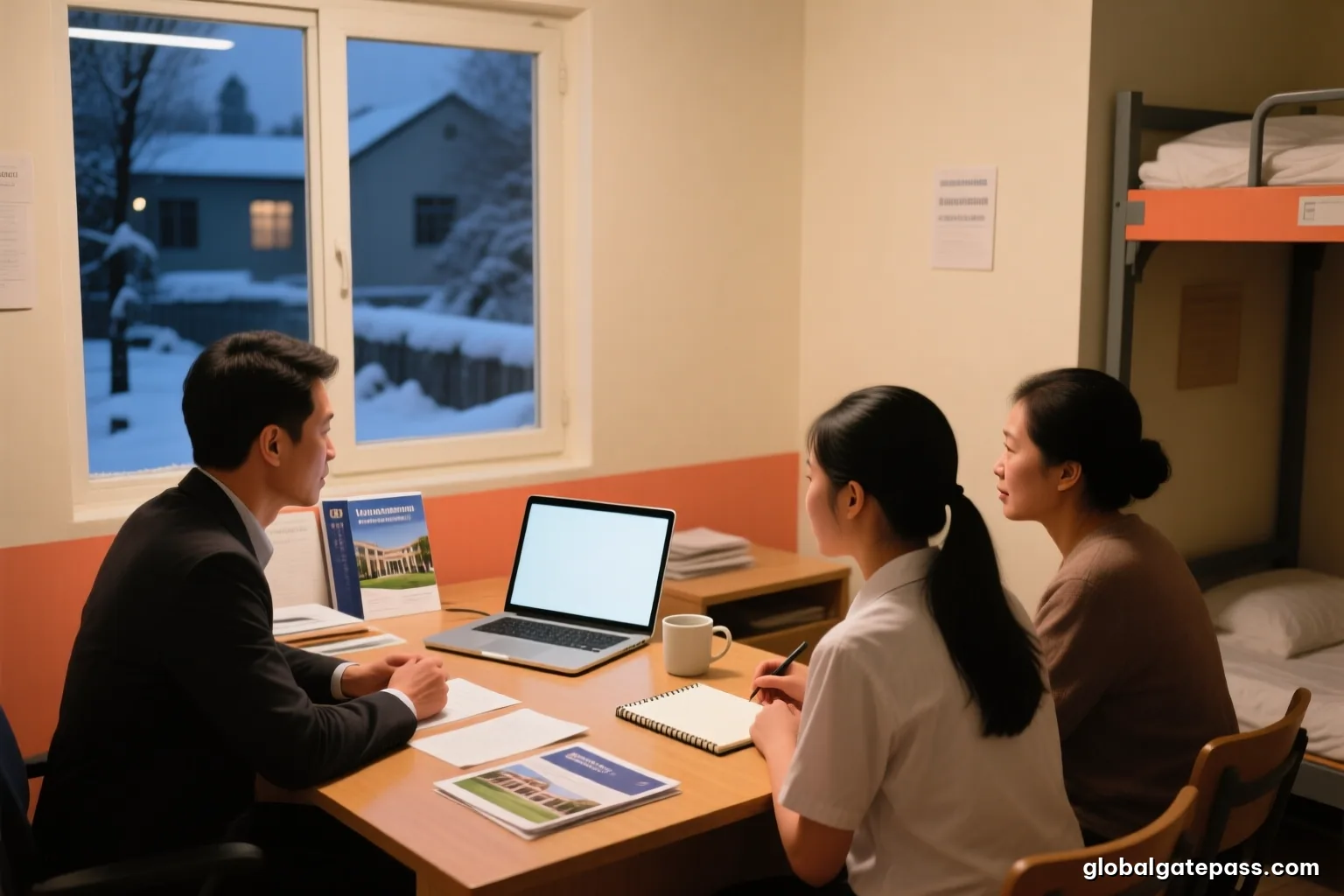
Yes. Students in other provinces, working adults in another city and people living abroad can all work with Global Gate Pass over Zoom or Google Meet, from the first consultation to the visa application. The one-to-one mentor model does not depend on sitting in the same room: the student still has one mentor responsible throughout, still has a written Roadmap, and still has regular meetings and a messaging channel for questions between sessions.
The Global Gate Pass office is on the 1st floor of Jamona Heights, 210 Bùi Văn Ba, Tân Thuận ward, Ho Chi Minh City, but most study abroad advising work — reading applications, commenting on essays and discussing strategy — can be done remotely. This article explains which parts can be done entirely online, which parts still require the student to be present at a specific place, and how to keep the working rhythm going when the two sides are hundreds of kilometres apart.
How an online first session works
An online first session has the same content as a meeting at the office: the mentor listens to the goals, reads the school record, asks about the budget and gives a frank view of feasibility. The main difference is the preparation. The family should send scans of the school report or transcript, and any test results, in advance so the mentor can read them beforehand instead of spending session time on screen-sharing.
Both the student and at least one parent should be on the call, even if they are in two different places. Studying abroad is a decision for the whole family; a session with only the student usually has to be repeated when the parents want to ask about costs and risks. A call on a computer works better than on a phone, because the mentor sometimes needs to show a comparison table or a page of school information.
The session lasts about 60 to 90 minutes, as an in-person one does, and is free with no obligation to sign a contract afterwards. When the family is abroad, appointments are scheduled within Ho Chi Minh City working hours, Monday to Saturday; Sundays are arranged by special appointment if the time difference makes those slots too difficult.
What can be done fully online, and what needs you to be there
The table below divides the work by how far it can be done remotely. The last column says clearly who must be present, because many procedures require the applicant to attend in person and nobody can do them on their behalf.
| Item | Can it be done online? | Notes |
|---|---|---|
| First consultation, strategy, Roadmap | Fully | The Roadmap is sent as a file and both sides go through it together in the meeting |
| Feedback on essays, recommendation letters, CV | Fully | Done on shared files, with a revision history for each round |
| Submitting on school portals, tracking results | Fully | The student keeps the accounts; the mentor follows the progress tracker |
| School or visa interview practice | Fully | For many schools, a video interview is even closer to the real thing |
| Sitting tests, giving biometrics, the consular interview | No | The student must attend the test centre, the application centre or the consulate in person |
| Notarisation, translation, bank documents | Partly | The family handles these locally, following the checklist the mentor sends |
For students in other provinces, the parts that require a trip to the city usually come down to a few journeys: sitting a test if there is no test centre locally, and giving biometrics and attending a visa interview if the country requires them. The mentor groups these tasks into the same trip where possible to save the family travel. The document list for the student's destination country is sent as a checklist, stating which papers need originals and which need certified translation, so the family can do them all in one go locally.
Keeping the rhythm without meeting in person
The biggest risk of working remotely is not the connection but the rhythm. Without fixed appointments, an application can easily drift for weeks with nobody chasing it. So right after signing, the mentor and the student set a regular meeting schedule, usually one session every one or two weeks depending on the stage, plus a messaging channel for small questions between sessions.
Every meeting ends with a task list for the following week, saying clearly who does what and by which date. The next meeting opens by going through that list. It is a simple method, but it keeps progress on track better than any general reminder, and parents far away can look at it to know where their child stands.
Mentors reply to messages during office hours. Urgent matters tied to deadlines, such as a school asking for extra documents within a few days, are dealt with first. The family should let us know early when they know they will be busy, travelling for work, or when the student is heading into exams at school, so the mentor can move tasks to fit instead of piling them up at the last minute.
Students already abroad, with parents in Vietnam
A common group is students who are already abroad, for example in high school or a foundation programme, who want to move up to university or change country, while their parents in Vietnam handle the finances. In this case the mentor works with both ends: the student on academics and essays, the parents on the budget and financial documents. Joint sessions are scheduled at times when both sides are awake.
For applicants who are currently abroad, the mentor checks one more thing: where to apply for the visa. Some countries allow applications from the place where the applicant is lawfully resident; others require applications from the country of citizenship. The answer varies by country and over time, so the mentor checks the current rules of the visa authority before fixing the schedule. Parents in Vietnam are usually the financial sponsors, so signatures, bank statements and income documents must match what the student declares abroad; the mentor cross-checks both ends before submission.
If the student wants to change school or programme while studying, the mentor also points out the constraints of the current visa, because changing without following the rules can affect residence status. This is guidance only; specific immigration procedures in the host country must follow the instructions of the school and the competent authorities there.
Contracts, confidentiality and documents when working remotely
Signing the contract: the service contract can be sent electronically so the family can read it in advance and has time to ask about each clause before signing. How it is signed and how the original is sent are agreed according to each family's circumstances.
Confidentiality of records: school reports, bank statements and property papers are the family's private information. Shared files are open only to the people working directly on the application, and the family should send documents through the agreed channel rather than scattered across several apps.
Original documents: most application portals accept scans. Originals are needed only for the visa application, notarisation or when a school asks for documents by post; the mentor says in advance which tasks need originals so the family does not have to send things back and forth.
Payments: every service fee is written in the contract. School fees, visa fees and test fees are paid by the family directly to the receiving body following its official instructions, never through anyone's personal account.
When it is worth coming to the office even from far away
Online is enough for most applications, but there are a few moments when meeting in person is worth the journey. The first is when the family is still torn between several very different directions and wants to sit down with the mentor for a long discussion. The second is the final visa interview practice for countries that interview in person, because sitting in front of a questioner feels very different from looking at a screen. The third is when parents want to meet the person who will be supporting their child for the whole of the coming year.
If the family is coming to Ho Chi Minh City for something else, such as a test or a biometrics appointment, a meeting can be arranged on the same day. Book at least a day ahead through the form on the Contact page or the hotline in the footer so the responsible mentor can schedule it. Before coming, the family should write down the questions it wants to discuss face to face, so the meeting does not drift into things that could be done over a call.
On the other hand, some things do not need a visit to the office even if the family would very much like to meet for peace of mind, such as handing in scanned documents or signing off an updated Roadmap. Travelling for those only costs the family time and money. The mentor will say clearly which sessions are worth meeting in person and which are fine over a call, so that any trip to the city is used for things that really need a face-to-face meeting. For families abroad, an in-person meeting can be scheduled during a visit home to Vietnam for the holidays or the summer break, when both the student and the parents are present, instead of trying to arrange a separate trip just to sit with the mentor.
Common problems when working remotely, and how we handle them
The most common problem is scattered documents: the school report on a parent's phone, the essay on the student's computer, the school's confirmation letter in someone else's inbox. From the first month, the mentor sets up a shared folder for the application, organised by category, and every new version goes into it. That way, when an application portal asks for a file, nobody has to dig through old messages to find it.
The second problem is a student going quiet. When working remotely, a student stuck on an essay may not send a message for two weeks out of embarrassment. The mentor handles this by breaking the task into smaller pieces, arranging a short session just to unblock the exact point where they are stuck, and telling the parents when progress falls behind the Roadmap, so the whole family knows rather than discovering it close to the deadline.
The third problem is mismatched information between family members. When parents are in one place and the student in another, it is easy for each person to understand a deadline or the amount of money to prepare differently. The simple fix is that after each important meeting, the mentor sends both sides a short note of what was agreed. Anyone who reads something that does not look right asks straight away, before the work is done on a misunderstanding.
Frequently asked questions
Is online advising any different in quality from meeting in person?
The work is the same: the same mentor, the same Roadmap, the same rounds of feedback on the application. The difference is in the rhythm, which is why online work always has a fixed meeting schedule and a task list after every session.
Is there a fee for an online first session?
No. The first session, online or in person, is free, lasts about 60 to 90 minutes and carries no obligation to sign a contract. The family should send the school report in advance so the mentor can read it beforehand.
When do students from other provinces need to come to Ho Chi Minh City?
Usually only to sit a test if there is no test centre locally, or to give biometrics or attend a visa interview. The mentor tries to group these into the same trip to save the family travel.
Can I work on my application with Global Gate Pass while living abroad?
Yes. The mentor schedules meetings around both time zones and checks in advance the rules for applying for a visa from where the student lives, because each country has different rules on where you may apply.
How can parents who are not comfortable with technology take part?
All you need is a phone or computer with Zoom or Google Meet, which the student can install for you. Important documents such as the Roadmap and the contract are sent as files so parents can reread them at their convenience.
Is it safe to send financial documents online?
The family should send them through one channel agreed with the mentor, not scattered around. Files are open only to the people working directly on the application, and originals are used only when a procedure genuinely requires them.