A portfolio for a creative subject is well built when it shows how the student thinks, not just what the student can draw: there is a sketchbook recording the process, one or two themes running through it, work drawn from direct observation, and short captions stating intentions. The final submission is only the tip of the iceberg; most of the work lies in the year or two of building the habit of drawing, making and recording beforehand.
At Global Gate Pass, portfolios for art, design and architecture are coached by the mentor in charge of the application together with a subject adviser. The mentor handles university strategy, the timeline and how the portfolio fits with the rest of the application; the subject adviser gives feedback on the work. This article describes how the two work together at each stage, and the mistakes that often lead to Vietnamese students' portfolios being rated poorly.
Why start with a sketchbook rather than finished work
Most students think a portfolio is a collection of their best pieces. In reality, many committees at art and design schools want to see the process: what the student observes, which directions they try, which they abandon and why. The sketchbook is where these things show most naturally, and some schools require or encourage submitting a few sketchbook pages alongside the main pieces.
So the first thing the mentor and subject adviser do with the student is not choosing pieces but building a daily habit of drawing and note-taking. A sketchbook carried everywhere, quick drawings of what you see at school, on the bus, at the market; notes on ideas; material samples stuck in; one detail drawn again and again. After a few months, these sketchbooks become a seam of material to develop into larger pieces.
Students who have trained for Vietnam's arts aptitude entrance exams usually have strong figure-drawing skills but few sketchbooks, because the training focuses on finished exam pieces under time limits. This is not a weakness that cannot be fixed; it just needs to be made up with a few months of deliberate recording before choosing pieces.
Finding a theme: what ties the pieces together
A strong portfolio usually has one or two themes the viewer recognises after a few pages: a recurring interest, a personal way of seeing, a material the student explores in depth. A theme is not a brief imposed from outside; it is usually discovered by looking back through the sketchbook and noticing that the student keeps coming back to one thing.
A hypothetical example: a student who wants to study graphic design realises she draws a great many hand-painted signs in the alleys. The theme might be handwritten lettering in urban space, which could develop into a series: on-the-spot sketches, a study of letterforms, a redesign for a small café, a self-made publication. A student who wants to study architecture might explore how families in narrow tube houses make use of light and wind.
A theme helps the committee remember the student, and gives the accompanying essay something to say. Even so, a portfolio should not have only one theme; it still needs a few pieces showing core skills such as drawing from observation, composition, colour, and the ability to work in several media.
Rounds of feedback with the subject adviser
The subject adviser meets the student on a regular schedule. Each round has its own focus, so the student does not have to take in all the feedback at once. The table below shows a typical sequence; the number of rounds and the gaps between them vary with the time remaining.
| Round | Focus | The student brings | After this round the student |
|---|---|---|---|
| First round | Assessing the foundation: skills, habits, gaps | Everything they have, including exam practice pieces and old sketchbooks | Starts a regular sketchbook and observational drawing exercises |
| Theme round | Looking back through the sketchbook for what the student returns to most | Three or four months of sketchbooks | Chooses one or two themes and sketches a plan for a series |
| Development rounds | Each piece in the series: idea, experiments, completion | Trial pieces, photos of work in progress | Continues, tries other materials, drops directions that lead nowhere |
| Selection round | Choosing the submission set for each school's requirements | All finished work | Photographs the work, writes captions, sets the order |
| Final check | Photos, captions, order, fit with the essay | The complete submission set in each school's format | Submits, and prepares for a portfolio interview if there is one |
The mentor in charge of the application sits in on the first round and the selection round, to make sure the portfolio fits the university list, the deadlines and the rest of the application. Between rounds, the mentor follows progress in the monthly meeting as with every other application.
Photographing work and writing captions: the part often done carelessly
Most schools receive portfolios as images uploaded to an online system they specify, with limits on the number of pieces, file size and format. The committee does not see the real work; it sees photographs. A good painting photographed at an angle, with a yellow cast, a hand's shadow or a cluttered background, will look much worse than it really is.
Mentors tell students to photograph flat work under even light, without flash, with the camera parallel to the surface; three-dimensional work should be photographed from several angles against a plain background. Edit images only to bring the colours close to reality, never to change the content of the work. Each piece should be photographed as soon as it is finished, because left too long it may be damaged or lost.
A caption usually includes the title, medium, dimensions, year, and one or two sentences on intention or context. A caption is not the place for long explanations or grand language. A sentence such as "A series of records of handwritten lettering in the alleys around the market, drawn on the spot in fineliner, later redesigned as a typeface for the drinks stall at the head of the alley" is a hypothetical example of informative writing without self-praise.
Mistakes that lead to a portfolio being rated poorly
Subject advisers and mentors see a number of mistakes recur in students' portfolios. Most can be fixed if caught before the selection round:
- Redrawing from existing photos. Copying images from the internet, however accurately, shows copying skill but not a way of seeing. Committees prefer drawing from direct observation.
- Nothing but exam practice. Plaster casts, still lifes and colour compositions set to exam briefs show a foundation, but a portfolio of only those looks like homework.
- No process. Only finished pieces, with no sketches or experiments, so the committee cannot see how the student thinks.
- A borrowed style. Drawing in the style of famous comics or animation without a personal twist is usually read as lacking an individual voice.
- Not reading each school's requirements. Each school has its own number of pieces, format and sometimes its own brief. One set submitted to every school easily ends up with too much or too little.
- Work done by someone else. Having someone else rework the pieces too heavily is a serious violation, and usually comes out in the portfolio interview.
Subject advisers give feedback verbally and with illustrative sketches on separate paper; they do not draw on the student's work. This is the same line Global Gate Pass holds with essays: coach, do not do it for them.
An illustrative case: an aptitude-exam student moving to an international application
The following case is constructed for illustration. A Grade 11 student who has spent two years training for the arts aptitude exam and draws very solidly wants to change direction and study architecture abroad. All his existing work is plaster casts, still lifes and colour compositions set to exam briefs.
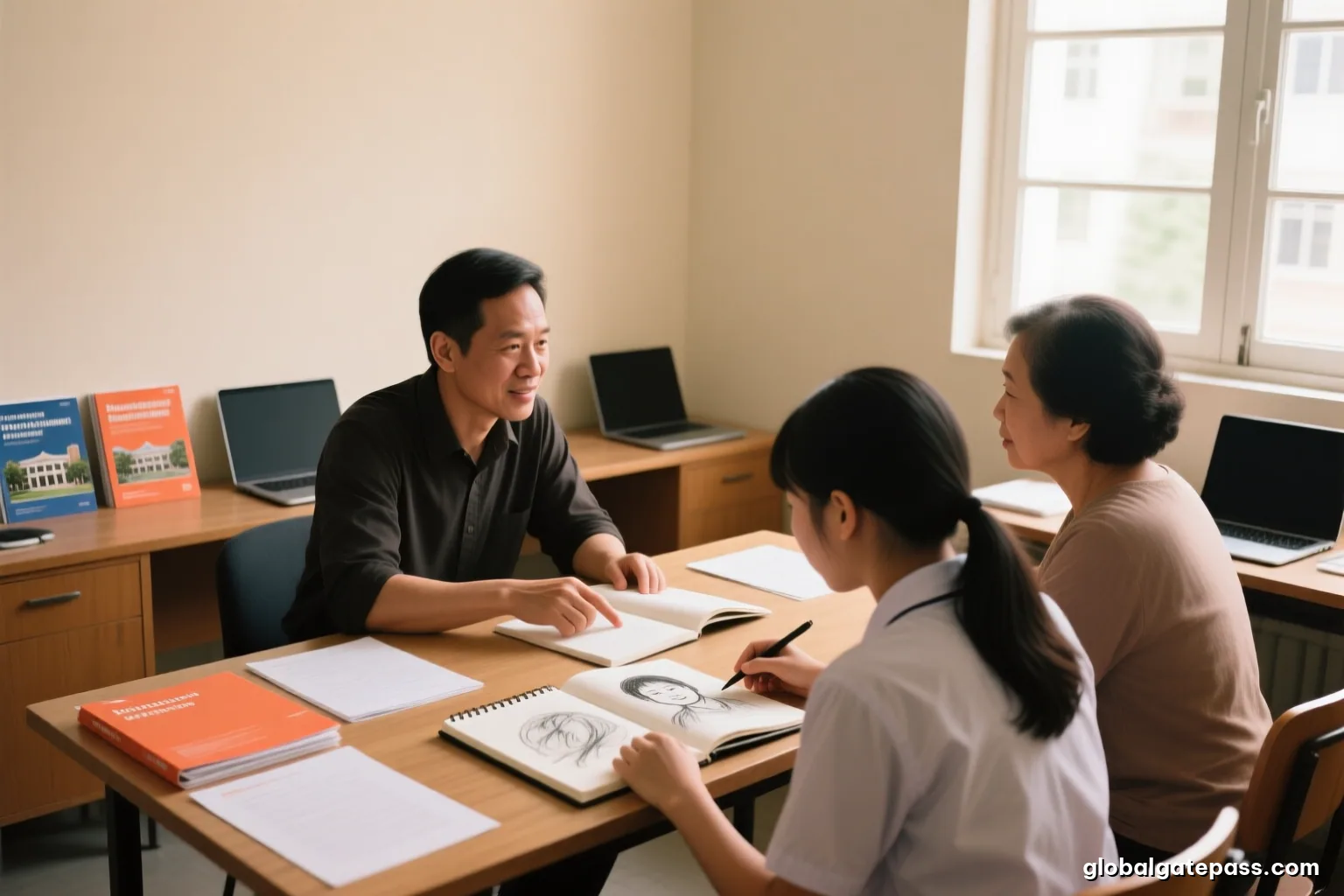
In the first round, the subject adviser keeps two or three of his best figure drawings as evidence of core skills, then gives him a sketchbook with a weekly exercise: draw a real space, paying attention to the light and how people move through it. After three months, he finds himself returning again and again to the staircases and light wells in the tube houses of his neighbourhood.
That theme is developed into a series: on-the-spot records, hand-drawn sections, cardboard models, and a small renovation proposal for his own family's house. The final portfolio still shows traces of his exam training, but its core is a personal way of seeing living space. The mentor in charge of the application uses that same theme as the backbone of the essay and of his explanation of why he chose architecture.
Portfolio interviews: talking about your own work
Some art, design and architecture schools invite students to a portfolio interview, in person or online. The interviewer usually opens a few pieces and asks what the student was thinking, what they tried, why they chose that material, and what they would change if they did it again. This is when a portfolio with a sketchbook and a genuine process shows its value: the student has plenty to say, because every decision was recorded.
The mentor and subject adviser practise portfolio interviews by having the student present five or six pieces, a few minutes each, then asking probing questions. The aim is not to memorise answers but to get used to talking about your work in concrete terms: where the light comes from, why the composition is cropped there, which part did not work. Students whose spoken English is not yet fluent can still present well if they know their own work thoroughly.
The portfolio and the rest of the application
The portfolio matters for creative subjects, but it does not stand alone. Comprehensive universities with design or architecture programmes still assess the transcript, language ability and essays; specialist art schools usually weigh the portfolio more heavily but still have academic and language thresholds. Mentors balance the university list so that the portfolio and the other parts are all sufficient for each place.
The portfolio timeline must also run in parallel with the test and essay timelines. A student who pours everything into their work in the final year and misses a test date is a situation mentors try to avoid from the moment they draw up the Roadmap. Families whose child is considering a creative subject and does not know where to start with a portfolio can book a free 60-minute first session through the form on the Contact page; the mentor will look at what the child already has and say frankly what gaps remain.
Frequently asked questions
Which grade is the right time to start preparing a portfolio?
The habit of drawing and keeping a sketchbook should start in Grade 10, so that by Grade 11 there is enough material to find a theme and develop a series. Students who start later can still do it, but will need to narrow their list of schools and accept a simpler submission.
Can digital work go in the portfolio?
Yes, and for graphic design, animation or interaction design it is often needed. Even so, many schools still want to see hand drawing from observation. Students should have both, unless a school's requirements say otherwise.
Does an architecture portfolio require 3D modelling software skills?
Usually not at undergraduate level. Committees care more about the ability to observe space, draw by hand, build models and think through problems. Knowing software is a small plus if it serves the idea.
Can the same portfolio be used for several schools?
Most of the work can be shared, but the number of pieces, order and format must be adjusted to each school's requirements. Some schools set their own brief, which requires making extra work to match.
Does the subject adviser draw or correct work for the student?
No. The adviser gives feedback verbally and with illustrative sketches on separate paper. The work must be done by the student, because that is an ethical requirement of the application and because the student may have to present their process in an interview.
Should a student who has never had formal drawing training apply for design?
They still can, especially for product design or interaction design, where thinking and process are valued. The student needs more time to build core skills and a sketchbook, and the mentor will adjust the list of schools accordingly.